
Commercial Basement Dehumidifier Cost: Installation vs. Retail Units
Written by the Dehumidifier for Basement editorial team and reviewed for source accuracy. — last updated August 2026. Editorial policy
Quick answer
A retail 50-pint basement dehumidifier runs about $200-$350. A commercial or crawl-space-rated unit is roughly $1,200-$2,500 for the equipment and $2,000-$4,500 installed with ducting, a dedicated drain and a condensate pump.
The price gap between a store-shelf dehumidifier and a commercial-grade basement or crawl space system looks brutal until you compare what each one is actually built to do. One is a seasonal appliance sized to pull moisture out of the air in a room. The other is a permanently installed piece of building equipment sized to hold an entire below-grade envelope at a target humidity every hour of the year, including the hours nobody is home.
This guide breaks down both price tags honestly — equipment, installation, electricity and expected service life — so you can see where the money actually goes and decide whether your basement needs an appliance or a system.
Retail vs. commercial: the numbers side by side
| Factor | Retail portable unit | Commercial / crawl-space system |
|---|---|---|
| Equipment price | $200-$350 | $1,200-$2,500 |
| Professional installation | None (plug it in) | $800-$2,000 |
| Total installed | $200-$350 | $2,000-$4,500 |
| Rated capacity (DOE 2019) | 20-50 pints/day | 70-130+ pints/day |
| Effective coverage | 500-1,500 sq ft | 1,500-5,000 sq ft |
| Energy factor | ~1.6-2.0 L/kWh | ~2.5-3.5 L/kWh |
| Runs at 50°F? | Often struggles or frosts | Yes — designed for it |
| Drainage | Bucket or gravity hose | Hard-piped drain + condensate pump |
| Filtration | Washable mesh | MERV-rated media filter |
| Expected service life | 3-5 years | 10-15 years |
| Warranty | 1 year typical | 5-6 years typical |
Where the extra money actually goes
A commercial unit is not simply a bigger box. Four engineering differences drive most of the cost.
Most homeowners land here after a residential unit fell short, which is usually a sizing question first — see the basement capacity chart and, before spending on larger equipment, the point at which no dehumidifier is the answer. Running costs for either class of machine can be modelled in the electricity cost calculator.
1. Low-temperature operation
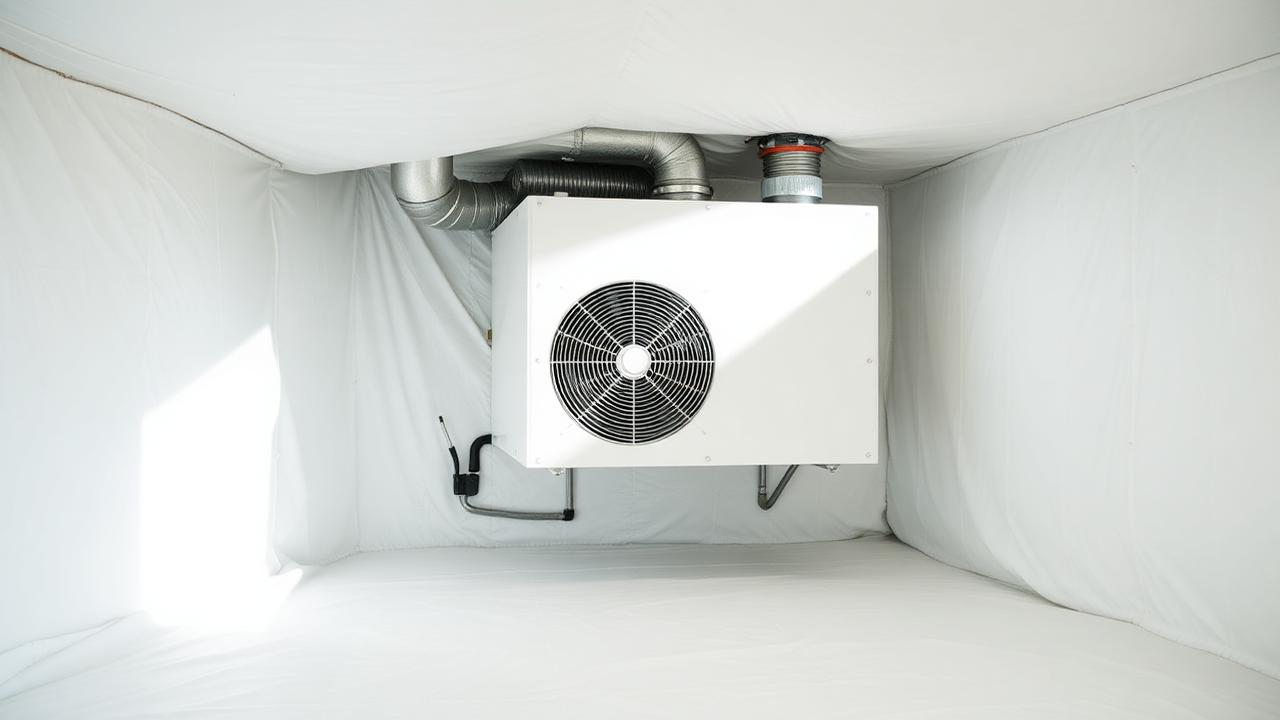
Retail compressors lose efficiency fast below about 65°F and many frost their coils in a 55°F crawl space. Commercial units use hot-gas bypass defrost so they keep dehumidifying at 40-50°F. That single feature is the reason a crawl space unit can hold humidity through October to April, when a portable is effectively off.
2. Energy factor
Energy factor measures liters of water removed per kilowatt-hour. A typical portable lands near 1.8 L/kWh; a good commercial unit reaches 2.5-3.5 L/kWh. At $0.173/kWh, removing the same amount of water can cost 30-45% less per season on the commercial machine — which is how a $2,500 install slowly claws back part of its price.
3. Ducting and air distribution
A portable dries the air within a dozen feet of itself. A ducted system pulls from the far corner of the basement and discharges at the opposite end, so the whole volume turns over instead of one hallway drying while the storage room stays at 65% RH.
4. Permanent, gravity-independent drainage
This is the part homeowners underestimate. A commercial install includes a hard-piped condensate line, a pump when the drain sits above the unit, and a high-water safety switch that shuts the equipment off before a failed line floods the slab. On a retail unit, the drain is a garden hose you routed yourself.
Find a licensed local specialist
We can't fix standing water or structural issues with an appliance — but we can connect you with someone who can.
Your ZIP code is stored securely so we can check licensed specialist availability in your area. We never sell your information to unsolicited marketers.
When the higher upfront cost is the cheaper decision
- Below-grade square footage over 1,500 sq ft. Two portables running continuously cost more in electricity than one right-sized commercial unit, and still leave dead zones.
- An unconditioned crawl space. Encapsulation plus a low-temperature dehumidifier is the standard assembly; a portable in a crawl space is a frost machine.
- Finished space with drywall, flooring or cabinetry below grade. Replacing 400 sq ft of water-damaged finished basement typically runs $8,000-$25,000. That is the number the equipment price is actually competing against.
- Documented humidity above 60% for months at a time. Sustained high RH is what feeds mold growth on organic building materials, per EPA guidance on moisture control.
- Stored items you cannot replace — records, instruments, electronics, inventory.
Why professional installation is part of the price
Commercial units are usually sold through contractors rather than retail for a practical reason: the equipment only performs as designed when the drainage, air path and electrical supply are done correctly.
- Drainage slope and termination. A condensate line has to fall continuously to an approved drain or be pumped. Getting this wrong is how a moisture-control project becomes a water-damage claim.
- Dedicated circuit. Larger units draw 6-9 amps continuously and should not share a circuit with a sump pump or freezer.
- Duct sizing and static pressure. Undersized ducting starves airflow, which drops capacity below the rating you paid for.
- Vapor barrier and air sealing. In crawl spaces the liner, seams and rim joist sealing determine whether the equipment ever reaches setpoint.
- Warranty validity. Most manufacturers require professional installation for the full multi-year warranty to apply.
- Code and permits. Condensate disposal and dedicated circuits are inspected items in many jurisdictions.
In other words, the installation line item is not padding — it is what guarantees optimal drainage and structural protection. A correctly installed unit protects the foundation, framing and finishes; an incorrectly drained one puts water next to them.
A realistic five-year cost comparison
| Line item | Two retail 50-pint units | One 90-pint commercial unit |
|---|---|---|
| Equipment | $600 (bought twice: $1,200) | $1,900 |
| Installation | $0 | $1,400 |
| Electricity, 5 years | ~$1,819 | ~$1,174 |
| Filters / service | ~$50 | ~$250 |
| Five-year total | ~$3,069 | ~$4,724 |
| Coverage at 50°F | Partial | Full |
The portable route is still cheaper on paper over five years. It stops being cheaper the moment cold-weather coverage matters, the moment you count a single flooring or drywall repair, or the moment you would have replaced the second pair of units in year six.
Questions to ask before you sign a quote
- What is the DOE 2019 pint rating, and at what temperature was it measured?
- Where exactly does the condensate terminate, and is there a pump with a safety shutoff?
- Is the unit on its own circuit?
- What is the warranty term, and does it require this installer to service it?
- Does the quote include a vapor barrier or air sealing, or only the equipment?
- What humidity setpoint will the controller hold, and can I see the readout?
Frequently asked questions
How much does a commercial basement dehumidifier cost installed?+
Most whole-basement or crawl space installations land between $2,000 and $4,500 in 2026 — roughly $1,200-$2,500 for the equipment and $800-$2,000 for labor, ducting, drainage and electrical.
Is a commercial dehumidifier worth it for a 1,000 sq ft basement?+
Usually not, if the space stays above 65°F and there is no active water entry. A correctly placed 50-pint retail unit with a continuous drain handles that case. The commercial case gets strong above about 1,500 sq ft, in cold crawl spaces, or where finished materials are at risk.
Can I install a commercial unit myself?+
Some are sold as DIY-capable, but the drainage, dedicated circuit and duct sizing are exactly what determines whether the unit performs and whether the warranty stands. Improper condensate routing is a flooding risk, which is why most manufacturers require professional installation for full coverage.
Does a bigger dehumidifier use more electricity?+
Not necessarily per unit of water removed. Commercial units generally have a higher energy factor, so they remove more liters per kWh. They draw more watts while running but reach setpoint faster and cycle off.
Will a commercial dehumidifier fix a wet basement?+
No. Any dehumidifier controls airborne moisture only. Water entering through cracks, joints or a failed drain line has to be corrected by drainage, grading or waterproofing work first.
Keep reading
Sources and methodology
Guidance on this page is drawn from federal agencies and industry standards bodies rather than our own laboratory testing. We do not test appliances in a laboratory and we do not publish product measurements we did not obtain from the manufacturer or a government listing.
- U.S. Environmental Protection Agency — Mold Course & moisture control guidance (keep indoor relative humidity 30–50%)Used for: Target indoor relative humidity range and mold-growth conditions. Last verified 2026-07-29.
- U.S. Department of Energy — Energy Conservation Standards and Test Procedure for DehumidifiersUsed for: Why capacity ratings changed: the current federal test procedure and its rating conditions. Last verified 2026-07-29.
- ENERGY STAR (EPA) — ENERGY STAR Certified Dehumidifiers product finderUsed for: Certification status, Integrated Energy Factor (IEF) values, and sizing guidance for dehumidifiers. Last verified 2026-07-29.
- Association of Home Appliance Manufacturers (AHAM) — Dehumidifier certification program and sizing guidanceUsed for: Capacity-by-condition sizing ranges and certified capacity verification. Last verified 2026-07-29.
- U.S. Energy Information Administration — Electricity explained — Electricity prices and factors affecting pricesUsed for: Default electricity rate used in operating-cost estimates (2025 annual average). Last verified 2026-08-12.
Written by the Dehumidifier for Basement editorial team and reviewed for source accuracy. Last updated August 2026. Found an error? Report it through our corrections policy.