Basement Dehumidifier Sizing Guide: Matching Pints to Square Footage
Written by the Dehumidifier for Basement editorial team and reviewed for source accuracy. — last updated August 2026. Editorial policy
Quick answer
Start from square footage and dampness: roughly 30 pints up to 1,000 sq ft, 50 pints for 1,000-1,800 sq ft, and 70+ pints above 1,800 sq ft or anywhere you see wet spots. All figures here use the DOE 2019 rating scale.
Sizing a basement dehumidifier is not guesswork, but it is easy to get wrong for one specific reason: the pint numbers on the box changed. In 2019 the Department of Energy moved dehumidifier testing from 80°F to 65°F, which is much closer to real basement conditions and produces a lower number for the same machine. A unit labeled 70 pints under the old standard is roughly a 50-pint unit today. Everything below uses the current DOE 2019 scale.
Step 1: Measure the actual conditioned square footage
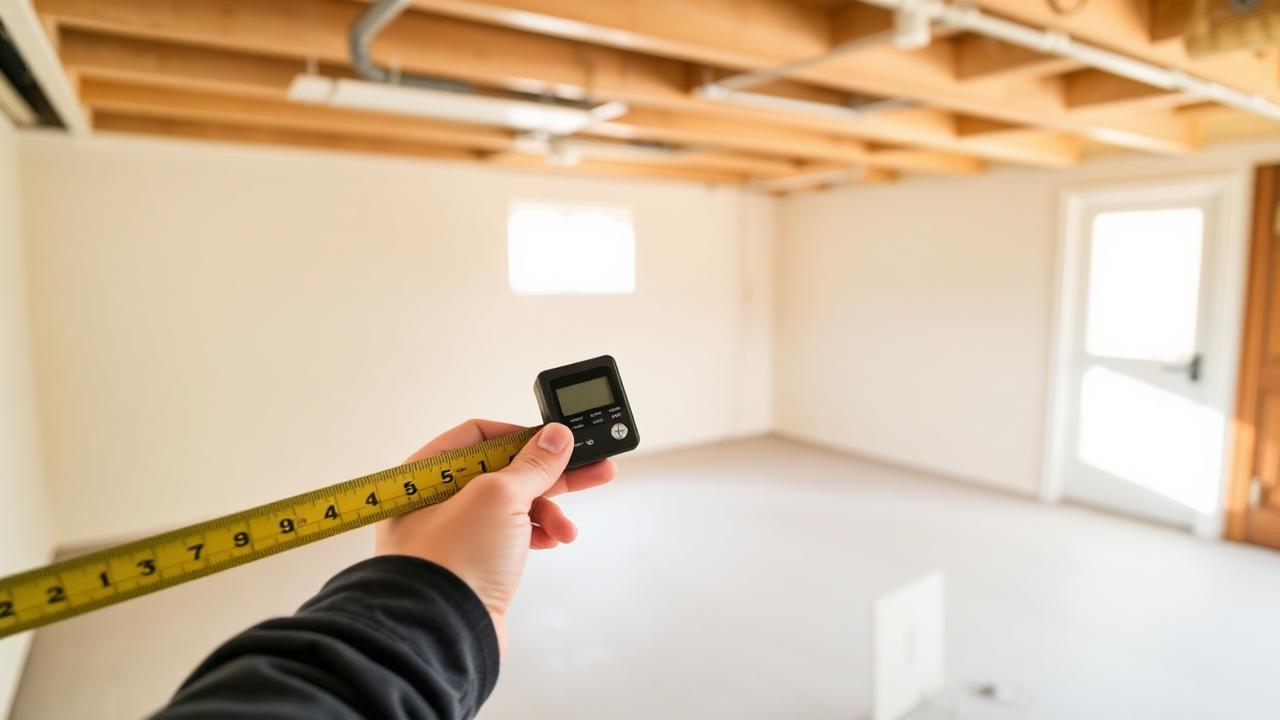
Measure length times width of the below-grade space the unit will serve. Count only areas air can circulate into. A 1,600 sq ft footprint chopped into a finished room, a mechanical room and a closed storage room behind a door is not one 1,600 sq ft space — it is three zones, and a single unit will only truly serve the one it sits in unless doors stay open.
Step 2: Measure the humidity, don't estimate it
A $15 digital hygrometer settles most sizing arguments. Leave it in the worst corner for 24 hours and record the peak. The EPA recommends holding indoor relative humidity between 30% and 50%; how far above that you currently sit is the second half of the sizing math.
- 50-60% RH — moderately damp. Air feels heavy, occasional musty smell after rain.
- 60-70% RH — very damp. Persistent musty odor, damp spots on walls or floor.
- 70-80% RH — wet. Visible dampness on walls, condensation on cold surfaces.
- Above 80% RH or standing water — extremely wet. Sizing is not the issue here; water is entering the space and needs a repair first.
Step 3: Read the sizing table
| Area | Moderately damp (50-60%) | Very damp (60-70%) | Wet (70-80%) |
|---|---|---|---|
| Up to 500 sq ft | 20-30 pints | 30 pints | 30-35 pints |
| 500-1,000 sq ft | 30 pints | 35-40 pints | 45-50 pints |
| 1,000-1,500 sq ft | 35-40 pints | 50 pints | 50-60 pints |
| 1,500-2,000 sq ft | 50 pints | 50-60 pints | 70 pints |
| 2,000-2,500 sq ft | 50-60 pints | 70 pints | 70+ pints or two units |
| Over 2,500 sq ft | 70 pints | 70+ pints | Whole-house or two units |
Step 4: Apply the real-world adjustments
The table is a starting point. Basements are not laboratory rooms, and five conditions justify moving up one size.
- Cold basement (under 65°F). Compressor capacity falls with temperature. Size up, and confirm the model is rated for low-temperature operation with auto-defrost.
- Unfinished with exposed masonry and an open crawl space. More surface area giving up moisture; size up.
- Frequent laundry, a shower, or a bathroom below grade. Each adds a steady internal moisture load.
- Multiple rooms or a closed door layout. Either size up and leave doors open, or plan on two units.
- Humid climate (Gulf Coast, Southeast, Ohio Valley). Outdoor dew point drives infiltration load all summer.
One reason to *not* oversize wildly
A dramatically oversized unit reaches setpoint quickly and short-cycles. That means less total dwell time across the coil, uneven drying, extra compressor wear and, on some models, more noise for the same result. One size up is insurance; three sizes up is waste. Getting within one step of correct is the goal.
What capacity actually costs to run
| Capacity | Typical draw | Per day | Per 30 days |
|---|---|---|---|
| 30 pints | ~300 W | ~$0.48 | ~$14 |
| 50 pints | ~500 W | ~$0.80 | ~$24 |
| 70 pints | ~700 W | ~$1.12 | ~$34 |
Note the counterintuitive part: an undersized unit often costs *more* than a right-sized one, because it never reaches setpoint and therefore never cycles off. Runtime, not nameplate wattage, drives the bill.
Sizing a crawl space is a different calculation
Crawl spaces run colder and are usually not conditioned, so standard portables frost up and stall. The pint figure matters less than the temperature rating: look for a unit rated to operate down to 40-50°F, sized for the encapsulated volume rather than the finished-room table above.
A worked example
A 1,400 sq ft unfinished basement in Ohio, measured at 68% RH in July, 63°F, with a washer and dryer below grade. Table row: 1,000-1,500 sq ft, very damp → 50 pints. Adjustments: cold space (+1 step) and laundry load (already accounted for by the very-damp column). Result: a 50-pint unit with low-temperature auto-defrost, continuously drained, set to 50% — or a 60-pint if the owner wants headroom for a wetter-than-average season.
Sizing checklist
- Measure the square footage the unit will actually serve.
- Log peak RH for 24 hours with a hygrometer.
- Find your row and column in the table above.
- Add one size for cold, unfinished, laundry, multi-room or humid-climate conditions.
- Confirm the model lists a DOE 2019 rating and low-temperature operation.
- Plan continuous drainage before you buy — capacity is meaningless when the bucket is full.
Find a licensed local specialist
We can't fix standing water or structural issues with an appliance — but we can connect you with someone who can.
Your ZIP code is stored securely so we can check licensed specialist availability in your area. We never sell your information to unsolicited marketers.
Frequently asked questions
What size dehumidifier do I need for a 1,000 sq ft basement?+
For a moderately damp 1,000 sq ft basement, a 30-35 pint unit is usually right. At 60-70% RH, step up to 40-50 pints. Add a size if the space runs below 65°F.
Is a 50-pint dehumidifier enough for a 1,500 sq ft basement?+
Generally yes for moderate to very damp conditions, assuming reasonably open air circulation and a temperature above 65°F. Cold, unfinished or multi-room layouts push it toward 60-70 pints.
Why do old and new pint ratings differ?+
The DOE changed the test temperature from 80°F to 65°F in 2019. The machine did not change — the measurement did. An old-standard 70-pint unit is about a 50-pint unit today.
Is it bad to buy a dehumidifier that is too big?+
Slightly oversized is fine and often helpful in a basement. Dramatically oversized short-cycles, which wastes energy and adds compressor wear without drying more effectively.
Do I need two dehumidifiers?+
Consider two when the space exceeds about 2,500 sq ft, when closed doors split it into zones, or when one end stays noticeably damper than the other despite a right-sized unit.
Keep reading
Sources and methodology
Guidance on this page is drawn from federal agencies and industry standards bodies rather than our own laboratory testing. We do not test appliances in a laboratory and we do not publish product measurements we did not obtain from the manufacturer or a government listing.
- U.S. Environmental Protection Agency — Mold Course & moisture control guidance (keep indoor relative humidity 30–50%)Used for: Target indoor relative humidity range and mold-growth conditions. Last verified 2026-07-29.
- U.S. Department of Energy — Energy Conservation Standards and Test Procedure for DehumidifiersUsed for: Why capacity ratings changed: the current federal test procedure and its rating conditions. Last verified 2026-07-29.
- ENERGY STAR (EPA) — ENERGY STAR Certified Dehumidifiers product finderUsed for: Certification status, Integrated Energy Factor (IEF) values, and sizing guidance for dehumidifiers. Last verified 2026-07-29.
- Association of Home Appliance Manufacturers (AHAM) — Dehumidifier certification program and sizing guidanceUsed for: Capacity-by-condition sizing ranges and certified capacity verification. Last verified 2026-07-29.
- U.S. Energy Information Administration — Electric Power Monthly — average retail price of electricity, residential sectorUsed for: Default electricity rate used in operating-cost estimates. Last verified 2026-07-29.
Written by the Dehumidifier for Basement editorial team and reviewed for source accuracy. Last updated August 2026. Found an error? Report it through our corrections policy.